If you’ve ever stared at your salary slip or a tax-saving checklist and wondered what the actual difference between PPF, EPF, and NPS is, you’re not alone. All three are government-backed, all three come up at tax time, and all three quietly hold a chunk of most Indian families’ long-term savings. But they’re built for different situations, and mixing them up can mean missing out on money that’s rightfully yours, or misunderstanding when you can actually access it.
This isn’t about which one to pick. It’s about knowing what each one actually is, so choosing — with a financial advisor, if needed — becomes a lot simpler.
PPF (Public Provident Fund): the one anyone can open
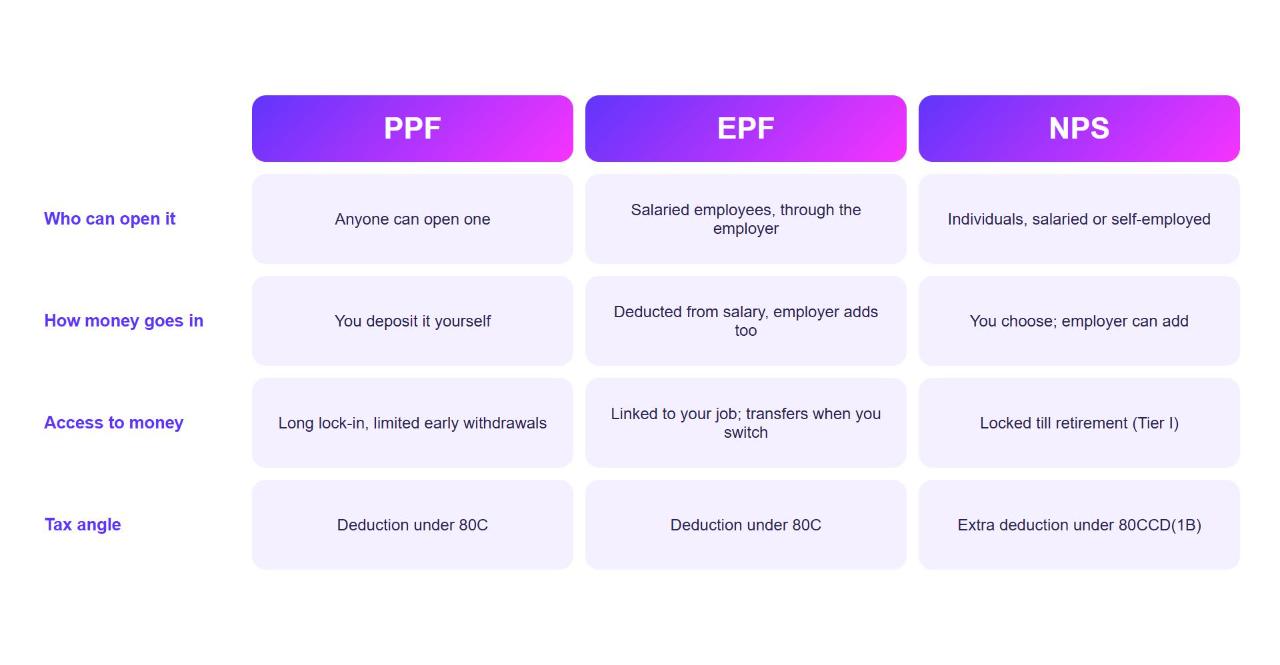
PPF is a government savings scheme open to any Indian resident — salaried, self-employed, or not working at all. You open it at a bank or post office, and you don’t need an employer to have one.
- How much you can put in: Minimum ₹500 and maximum ₹1.5 lakh in a financial year.
- How long your money is locked in: 15 years, extendable afterward in blocks of 5 years.
- Interest rate: Set by the government and revised every quarter — currently 7.1% per annum for Q3, FY 2026-27 (October–December 2026), compounded annually. This rate changes over time, so it’s worth checking the current figure before relying on it.
- Tax treatment: PPF carries “EEE” status — your contribution (up to ₹1.5 lakh) is deductible under Section 80C, the interest you earn is tax-free, and the maturity amount is tax-free too.
- Getting money out early: Partial withdrawals are allowed after 5 years, and you can take a loan against your balance between the 3rd and 6th year.
EPF (Employees’ Provident Fund): built into a salaried job
EPF is specifically for salaried employees at companies covered under the EPF Act. Unlike PPF, you don’t choose to open it — it’s set up automatically once you’re on a company’s payroll, and both you and your employer contribute every month.
- How the contribution splits: You typically contribute 12% of your basic salary plus dearness allowance; your employer matches with 12%, split as 3.67% into your EPF account and 8.33% into the Employees’ Pension Scheme (EPS).
- Interest rate: Declared annually by the EPFO’s central board — 8.25% per annum for FY 2025-26, credited each year on March 31.
- Tax treatment: Your own contribution is deductible under Section 80C. Interest stays tax-free as long as your own annual contribution doesn’t cross ₹2.5 lakh — beyond that, interest on the excess becomes taxable.
- Getting money out: EPF is meant to carry over as you change jobs, via transfer, and is typically accessed at retirement or under specific conditions like extended unemployment.
NPS (National Pension System): a retirement account you build yourself, with more tax room
NPS is a voluntary, market-linked pension account regulated by the PFRDA. Anyone between 18 and 70 can open one, whether salaried, self-employed, or a government employee, for whom certain rules differ.
- The tax benefit that makes it distinct: NPS is the only one of the three with its own extra deduction. Beyond the usual ₹1.5 lakh Section 80C bucket, you can claim an additional ₹50,000 deduction under Section 80CCD(1B) purely for NPS contributions. If your employer contributes to your NPS account, that’s deductible separately too, under Section 80CCD(2) — up to 10% of salary for most private-sector employees (14% for those under the new tax regime, and for government employees).
- Two account types: Tier I is the actual retirement account, locked in until you’re 60. Tier II is a voluntary add-on with no lock-in, but it doesn’t carry the same tax benefits.
- Getting money out at retirement: A portion can be taken as a lump sum, and the rest must go into an annuity that pays a regular pension. If your total NPS corpus is small — ₹8 lakh or less, under current PFRDA rules — you’re allowed to withdraw the whole thing without buying an annuity.
The difference that trips people up most: how “yours” the money is
PPF is entirely yours to open and control. EPF exists because of your job and largely tracks your employment. NPS is yours to open voluntarily, but it’s built specifically for retirement, with the strictest rules about withdrawing before 60. None of them behaves like a regular savings account — that’s the whole point.