
Here’s a fact most families quietly know but rarely act on: January 1st resolutions fade by March. The real window to course-correct is July — when half the year is still in front of you, tax season is just wrapped up, and school fees, monsoon travel plans, and the next EMI cycle are right around the corner.
A mid-year financial review isn’t about panic. It’s the equivalent of your car’s 10,000-km service — a quick check to make sure nothing’s slipped, everything’s on track, and you’re not about to be caught off guard.
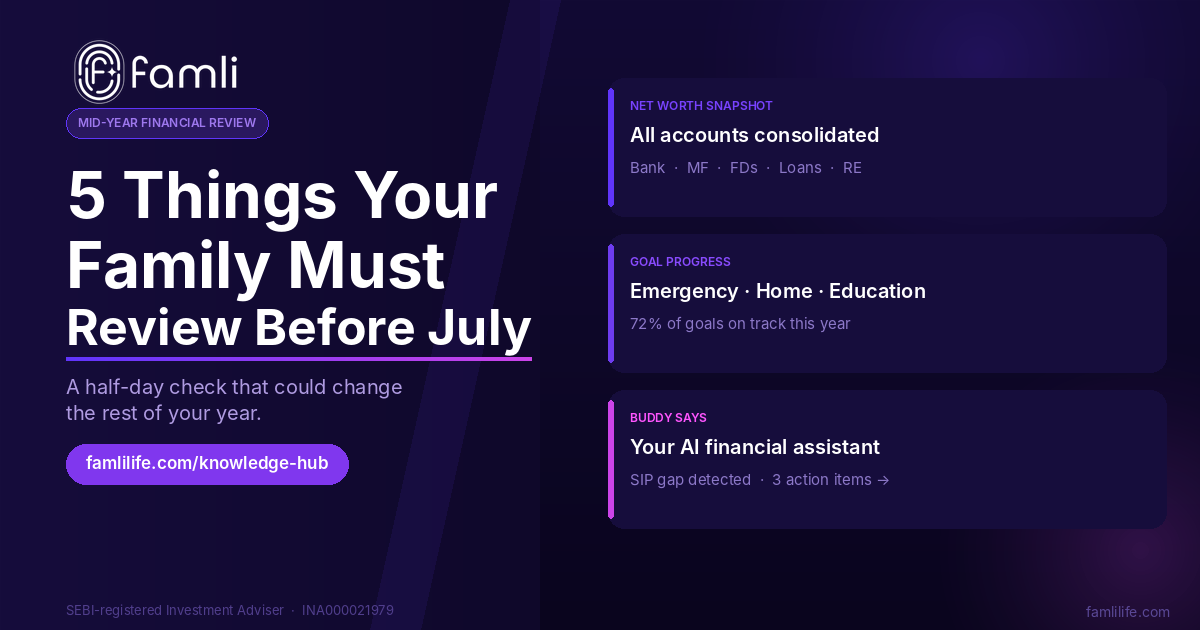
The good news? If your accounts are consolidated in one place, this entire review takes less than an afternoon. Here are the five things your family should check before July.

Check 01: Your Actual Net Worth
Do you know your family’s real number?
Most Indian families have wealth spread across four or five places simultaneously — a savings account in one bank, a mutual fund SIP started three years ago on one app, an FD that auto-renewed in another bank, a home loan outstanding with a third lender. Ask a family to quote their net worth and you’ll usually get an awkward pause.
Net worth isn’t complicated. It’s:
- Everything you own (assets): bank balances, mutual fund current value, FD value, real estate market estimate, other investments
- Minus everything you owe (liabilities): home loan outstanding, car loan, personal loan, any credit card dues carried forward
The difference is your net worth. That’s the number.
The question for July is: has it moved in the right direction since January? If your income has been consistent, your SIPs have been running, and your EMIs are being paid — the number should be higher than it was six months ago. If it isn’t, something’s worth looking at.
What to do
Add up all assets across bank accounts, mutual funds, FDs, and real estate. Subtract outstanding loan principals. Compare with what this number looked like in January. Even a rough estimate is better than no number at all.

Check 02: SIP Health Review
Are your SIPs still doing what they were meant to?
A SIP you set up in 2022 for ₹5,000 a month was probably calibrated to your 2022 income, your 2022 goals, and your 2022 understanding of what those goals would cost. It’s 2026. Things have changed.
The SIP health check has three parts:
- Are all SIPs actually running? Bank mandate issues, low balance flags, or app glitches can silently pause a SIP. Verify each one has been deducting without interruption.
- Is the total SIP amount still appropriate? If your household income has grown but your SIP amount hasn’t moved in two years, you’re likely under-investing relative to your current capacity.
- Are the SIPs mapped to specific goals? “I have a SIP” is very different from “I have a ₹8,000/month SIP going toward my daughter’s education fund that I need in 10 years.” Goal-mapping turns a savings habit into a financial plan.
A rough benchmark: most financial planners suggest investing 20–30% of take-home income across all goal-based instruments. If your SIPs plus other investments are well below that, the mid-year is a natural time to step up.
What to do
Pull up your SIP list. Confirm every SIP deducted this month. Check the total amount against your current income. Identify which SIP is mapped to which goal — if they’re all just ‘savings’ without a purpose, that’s worth fixing.
Check 03: Emergency Fund Status
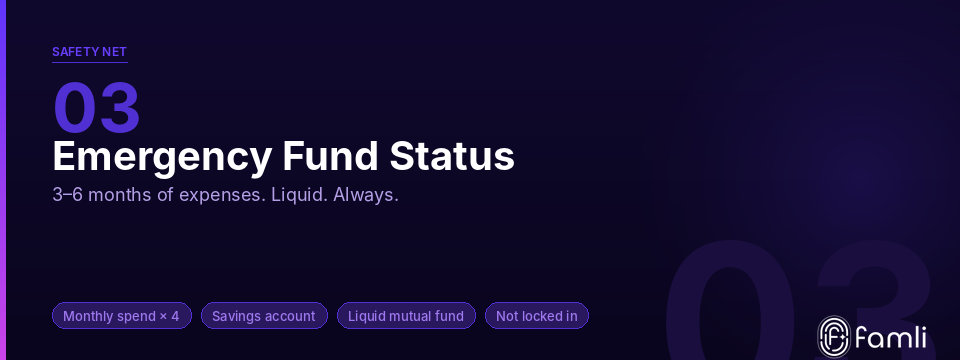
3–6 months of expenses. Liquid. Always.
The emergency fund is the most talked-about and least-maintained personal finance concept in India. Most people either haven’t built one, built one and gradually spent it on semi-emergencies (an AC breakdown, a wedding gift they couldn’t say no to), or have one sitting in a savings account earning 3.5%.
The rule of thumb is 3 to 6 months of household expenses — not salary. The distinction matters. A family earning ₹1.5 lakh a month but spending ₹1.1 lakh doesn’t need ₹9 lakh in emergency reserves — they need ₹3.3–6.6 lakh.
- Is the amount right? Take your actual monthly household spend — groceries, utilities, EMIs, school fees, petrol, everything — and multiply by 4. That’s the minimum.
- Is it actually liquid? An FD with a 2-year lock-in isn’t an emergency fund. Emergency money needs to be in a savings account, liquid mutual fund, or short-duration FD that can be broken within 48 hours with no penalty.
What to do
Calculate your average monthly expenses for the last 3 months. Multiply by 4. Check your liquid savings (savings account + liquid MF + easy-break FD). If the gap is significant, setting up a small monthly transfer to a dedicated savings account is the simplest fix.

Check 04: Loan & Liability Audit
What are you actually paying out every month?
Here’s an exercise most dual-income families haven’t done: add up every EMI, every credit card minimum payment, and every ‘buy now pay later’ instalment going out of your household every month. The total tends to surprise people.
Financial planning typically suggests keeping total EMI commitments below 40% of take-home income. Above that, you have very little flexibility for savings, emergencies, or discretionary spending. If two salaries are coming in but 50–55% is already committed to loan repayments, the household is running tighter than it feels.
- Total monthly outflow toward loans (home + car + personal + any other)
- The interest rate on each loan — especially personal loans and car loans. If you’ve maintained a good credit score and your loan is more than 2 years old, there may be scope to negotiate or refinance.
- Whether any loan was taken for a depreciating asset (car, gadgets, vacation) that is still running. These are the ones to consider prepaying if there’s spare liquidity.
What to do
List every loan, the current outstanding, the EMI, and the interest rate. Calculate total EMI as a percentage of your combined take-home income. If it’s above 40%, identify which loan to accelerate repayment on first — typically the highest interest rate one.

Check 05: Family Goal Alignment
Are both of you building toward the same future?
This one is less about spreadsheets and more about a conversation. Financial goals in a dual-income household can quietly drift apart — one partner is intensely focused on buying a larger home in two years; the other is prioritising financial independence and plans to take a sabbatical. Both are reasonable. But if they’re not aligned, the money will leak.
Questions worth discussing:
- Are we still targeting the same timeline for the goals we set at the start of the year?
- Has anything changed — job, income, family situation — that affects how we should be allocating money?
- Is there a goal we set that we’ve quietly deprioritised without formally deciding to?
- Are there new goals that have emerged (a parent who needs support, a course one of us wants to do) that we haven’t budgeted for?
The goal isn’t to have a perfectly optimised plan. The goal is to make sure both partners are looking at the same version of the future.
What to do
Block 30 minutes. Pull up your active goals — even if they’re just in your head — and compare notes. Identify one goal where progress has been slower than expected, and one thing you could do in July to move it forward.
Your Mid-Year Review Checklist
Here’s the full list to go through before the end of July:
- ☐ Calculate your family’s current net worth (assets minus liabilities)
- ☐ Confirm all SIPs are running and deducting correctly
- ☐ Map each SIP to a specific financial goal
- ☐ Calculate your emergency fund target (4 × monthly expenses)
- ☐ Verify emergency savings are in a liquid instrument
- ☐ List all outstanding loans and total EMI as % of take-home
- ☐ Identify any high-interest loan to prepay or refinance
- ☐ Have a goal alignment conversation with your partner
- ☐ Identify one financial decision to act on in July
A Note on Making This Easier
The biggest friction in a review like this is that the information is scattered. Bank statements in email. Mutual fund reports across three apps. Loan details on separate lender portals. Just gathering the numbers can take longer than actually reviewing them.
That’s exactly the problem Famli is built to solve. When all your family’s bank accounts, mutual funds, FDs, and loans are consolidated in one place — fetched automatically via the RBI-regulated Account Aggregator framework — the mid-year review goes from a half-day exercise to a 20-minute check.
Buddy, Famli’s AI assistant, can help you spot gaps — an SIP that’s paused, a loan-to-savings ratio that’s off, or a goal that’s fallen behind. Think of it as having a financially sharp friend who’s already looked at all the numbers before you sit down together.
Start your mid-year review with Famli
All your accounts. One dashboard. Your family’s actual number — in minutes.
Frequently Asked Questions
When should a family do a mid-year financial review?
The best time is June or early July — half the year is behind you, tax season is wrapped up, and the second half still has enough time to course-correct. A mid-year review gives you a clear view of whether your savings, SIPs, and goals are still aligned with what you planned in January.
How do I calculate net worth for my family?
Add up all assets: bank balances, mutual fund current value, FD value, and real estate estimate. Subtract all liabilities: outstanding home loan, car loan, personal loan, and any credit card dues. The difference is your family’s net worth.
How much should I keep in my emergency fund?
The target is 3 to 6 months of actual household expenses — not salary, but what you spend. Multiply your average monthly spend by 4 as a minimum. It should be in a liquid instrument: savings account, liquid mutual fund, or a short-duration FD that can be broken within 48 hours.
What percentage of income should go to SIPs?
Most financial planners recommend investing 20 to 30% of take-home income across all goal-based instruments including SIPs. If your total monthly SIP amount is significantly below this range, the mid-year is a natural time to step up.
What is a safe EMI-to-income ratio?
Financial planning guidelines suggest keeping total EMI commitments below 40% of take-home income. Above that, there is very little flexibility for savings, emergencies, or discretionary spending.
Disclaimer: Investments are subject to market risks. Famli is a SEBI-registered Investment Adviser (INA000021979). Registration does not guarantee performance of advice or assurance of returns. Please read all scheme related documents carefully before investing. The information in this article is for educational purposes only and does not constitute investment advice.