As parents cross 60, their financial lives don’t get simpler — they get more scattered. A pension here, a fixed deposit there, an old LIC policy nobody remembers the premium date for, a bank passbook in a drawer. At the same time, the stakes go up: the wrong POA clause, a missing nominee update, or a well-meaning but poorly timed conversation can create real problems later.
Managing a parent’s finances is not the same as managing your own. It involves someone else’s autonomy, their comfort with being “looked after,” and often, family dynamics between siblings. This guide covers what actually needs to be done — the paperwork, the legal basics, the fraud risks specific to seniors, and how to have the conversation without it feeling like a takeover.
Start With the Conversation, Not the Spreadsheet
Most adult children make the mistake of leading with logistics — “Send me your FD details” — before addressing the emotional layer. For most parents, finances represent independence. A conversation that starts with control triggers resistance; one that starts with care usually doesn’t.
A few things that tend to work better in practice:
- Frame it as backup, not takeover. “I want to know where things are, in case of an emergency” lands differently than “I’ll manage this now.”
- Start with one parent’s comfort area. Some parents are open about bank accounts but guarded about property or gold. Don’t insist on full disclosure in one sitting.
- Loop in siblings early. Money conversations that happen one-on-one, without other children aware, are a common source of family disputes later — even when there was no wrongdoing.
- Revisit it, don’t force it once. This is a series of conversations over months, not a single meeting.
Get the Paperwork in Order
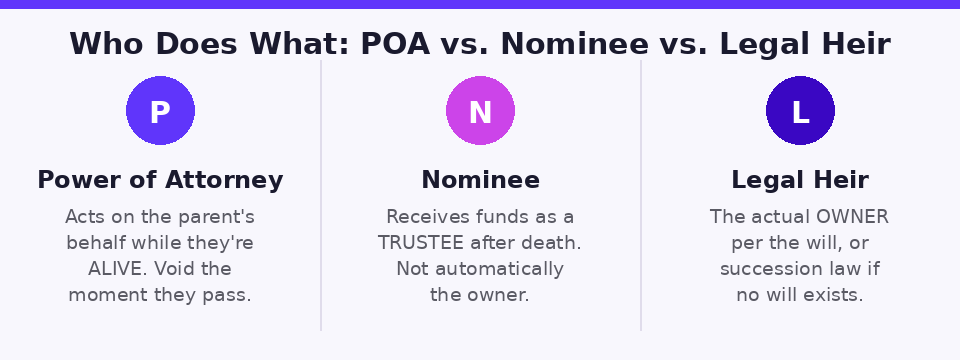
This is the part with the most confusion — specifically, the difference between a Power of Attorney, a nominee, and a legal heir. Each does something different, and mixing them up creates real problems.
Power of Attorney (POA)
A POA lets your parent authorize you (or another family member) to operate their accounts, pay bills, or manage property while they’re alive. It’s useful for parents who are mobile-limited or living separately from their children. Two things are worth knowing:
- A POA becomes void the moment the person who granted it passes away. It cannot be used to claim or distribute assets after death.
- A POA holder cannot appoint a nominee on the parent’s behalf — that has to be done by the account holder directly.
Nominee vs. Legal Heir
This distinction trips up most families. A nominee is not necessarily the owner of the asset — legally, a nominee receives the balance from the bank as a trustee, holding it until it’s passed on to the rightful legal heirs. A legal heir is who the law (via a will, or succession law if there’s no will) actually recognizes as the owner.
In practice: update nominees on every account regardless, because it makes the process of releasing funds faster. But don’t assume a nominee designation settles ownership — if there’s no will, succession law decides who the money legally belongs to, and courts have repeatedly upheld this over nomination.
As of 2025, most banks allow nominating up to four people per account, with a choice between simultaneous or successive nomination — useful for parents who want to divide holdings across children without a will covering every account.
Joint Accounts: “Either or Survivor”
Many families convert a parent’s savings account to a joint “Either or Survivor” account with an adult child. This allows either holder to operate the account independently, and on one holder’s death, the survivor can continue operating it with just a death certificate — no succession certificate needed for amounts up to ₹15 lakh, per RBI’s updated settlement-of-claims directions effective March 2026. It’s one of the simplest ways to avoid a paperwork bottleneck during a medical emergency, though it does mean the joint holder has full transactional access while the parent is alive — a trust call each family has to make on its own.
A Basic Will
Under the Indian Succession Act, 1925, a valid will needs no lawyer, no stamp paper, and no registration — just a clear written statement of your parent’s wishes, their signature, and attestation by two witnesses. Registration isn’t mandatory but adds a layer of protection against disputes, since the original is then held at the Sub-Registrar’s office. Every asset mentioned should be specific — account numbers, property survey numbers, folio numbers for investments — vague language is the most common reason wills get contested.