
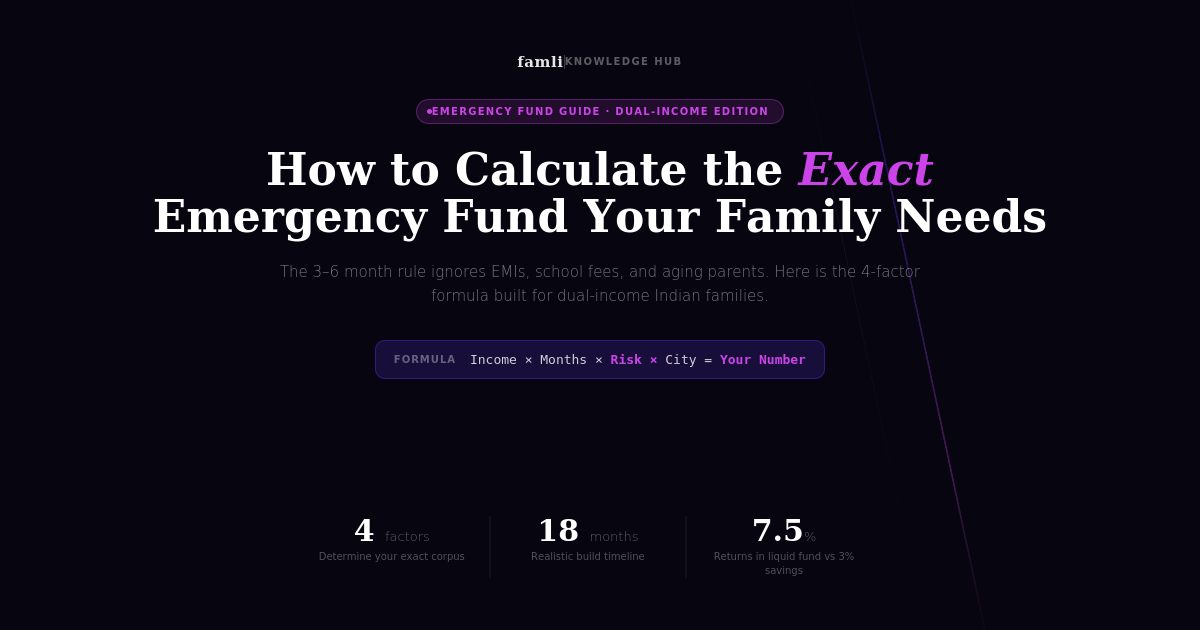
How to Calculate the Exact Emergency Fund a Dual-Income Indian Family Needs
The standard advice says: keep 3 to 6 months of expenses as an emergency fund.
That advice was written for a single person in a predictable financial situation. It does not account for what most Indian dual-income families actually look like: two salaries from different sectors, a home loan EMI that cannot be missed, a child in a private school, a monthly transfer to aging parents in another city, and two completely different levels of job stability between the partners.
For a family like that, “3 to 6 months of expenses” is not a plan. It is a guess. And depending on which direction you guess wrong, you are either dramatically underfunded — or you have locked away ₹15 lakh in a savings account earning 3% when it should be working harder.
This article builds the actual calculation from the ground up. Not a range. A number — specific to your income, your obligations, your sector risk, and your city.
Why “3–6 Months of Expenses” Is the Wrong Framework for Dual-Income Families
The 3–6 month rule comes from a world where one event is being hedged against: job loss. Three to six months is a reasonable average job search timeline for a skilled professional. But dual-income families face a fundamentally different risk profile — and the standard rule misses it in three important ways.
First, it uses the wrong income number. A family earning ₹1.85 lakh combined does not need to replace ₹1.85 lakh per month if one partner loses their job. They need to cover the gap between the one salary that continues and the fixed obligations that cannot stop.
Second, it treats “expenses” as a stable number. You cannot cut the EMI. You cannot pause school fees mid-term. You cannot tell your parents the transfer is on hold. The emergency fund must cover the rigid layer of spending — and for most Indian families, that rigid layer is 60 to 70% of total expenses.
Third, it ignores correlation risk. If both partners work in the same sector, then the dual-income hedge is weaker than it appears. Tech layoffs affect engineers and product managers simultaneously. A fund sized for one job loss may be catastrophically insufficient if both incomes are disrupted.
The Emergency an Emergency Fund Must Actually Cover
- Type 1: Income disruption. One partner loses their job, resigns, or is unable to work. Can last 3–9 months. Primary event the fund must cover.
- Type 2: Unexpected large expenses. Parent hospitalisation, car breakdown, urgent home repair. These arrive without warning.
- Type 3: Business or income volatility. If one partner is self-employed, income can drop without technically stopping.
Is a parent medical fund the same as an emergency fund?
No. Keep a separate corpus (₹50,000–₹1,00,000 per couple if insured). Combining it with your income-replacement emergency fund creates a situation where a parent’s hospitalisation depletes the very fund you need if you also lose income at the same time.
The 4-Factor Formula
Emergency Fund = (Lower Income × Coverage Months × Risk Multiplier) × (1 + City Adjustment)
Coverage period by sector:
- Both in large MNCs / Government: 4–5 months
- One MNC + one startup: 6 months
- One stable + one freelance/contract: 7 months
- Both in same sector: 8 months (correlation risk)
- One salaried + one self-employed: 9–10 months
Risk multiplier:
- No EMI, no dependents: 1.0×
- Home loan EMI only: 1.2×
- EMI + one child in school: 1.3×
- EMI + child + aging parents: 1.4×
- EMI + parents + medical risk: 1.6×
City adjustment:
- Mumbai / Delhi / Bengaluru: +15%
- Pune / Hyderabad / Chennai: +5%
- Tier 2 cities: 0%
- Tier 3 / semi-urban: –10%
Worked Example — Pune Family
Partner A (MNC, Pune): ₹1,10,000 | Partner B (startup, Pune): ₹75,000
Home loan EMI: ₹52,000 | School fees: ₹15,000/month | No aging parents
₹1,10,000 × 6 months × 1.3 × 1.05 = ₹9 lakh target corpus
Reference Table by Family Situation
| Family Situation | Coverage Period | Risk Multiplier | Target Corpus | Priority |
|---|---|---|---|---|
| Both in large MNCs / Govt No EMI, no children, Tier 2 city | 4–5 months | 1.0× | ₹3L – ₹4.5L | Moderate |
| One MNC + One startup, home loan EMI 1 child in school, Pune / Hyderabad | 6 months | 1.3× | ₹6L – ₹8L | High |
| One MNC + One freelance No children, Mumbai / Bengaluru | 7 months | 1.2× | ₹7L – ₹9L | High |
| Dual income + aging parents Monthly parent transfer + 1 child, any metro | 6–7 months | 1.4× | ₹9L – ₹12L | Critical |
| Both in same sector / company Home loan, 1–2 children, metro | 8 months | 1.5× | ₹11L – ₹15L | Critical |
| One salaried + one running own business Home loan, 1 child, parents semi-dependent | 9–10 months | 1.6× | ₹14L – ₹18L | Critical |
Where Should You Keep Your Emergency Fund?
| Instrument | Return | Liquidity | Verdict |
|---|---|---|---|
| Regular Savings Account | 2.5–3.5% | Instant | ❌ Avoid |
| Liquid Mutual Fund | 6.5–7.5% | T+1 (24 hrs) | ✅ Best |
| FD Ladder (3 / 6 / 12 months) | 7–8.5% | 1–3 days | ✅ Good |
| Sweep-In / Auto-FD Account | 5.5–7% | Instant | ⚠️ Acceptable |
How to Build ₹8L in 18 Months Without Disrupting SIPs
Contribute ₹44,000/month. 100% in liquid mutual fund. Do not pause SIPs.
→ Open a dedicated liquid fund. Automate transfer on salary day.
Move ₹2L into 6-month FD. Keep rest in liquid fund. Two-layer structure.
→ Create first FD. Set auto-renewal. Do not link to UPI.
Target reached. 3 months in 12-month FD, 2 months in liquid, 1 month in savings. Redirect ₹44K back to SIPs.
→ Review annually as expenses change.
Frequently Asked Questions
Should I include property down payment savings in my emergency fund?
No. They are separate buckets. Mixing them means you either deplete your down payment plan when emergencies hit, or you are left without proper emergency coverage.
What if we lose both incomes at the same time?
If both partners are in the same sector, apply 8-month coverage and 1.4–1.6× multiplier. For very high risk (both in same startup), consider 10-month coverage.
Can my emergency fund include my SIP investments?
No. SIPs are for long-term wealth. Tapping them during an emergency locks in losses and disrupts your wealth-building plan. Keep them completely separate.
How often should I review and adjust my emergency fund?
Annually. Recalculate when: income changes significantly, new fixed obligations appear, job stability changes, you relocate, or an aging parent becomes financially dependent.
How does self-employment change the calculation?
Use 9–10 month coverage instead of 6. Apply 1.4–1.6× multiplier. Business income declines slowly and unevenly — making it hard to know when to activate the fund. Build a larger corpus and review quarterly.
Investments are subject to market risks. Famli is a SEBI-registered Investment Adviser (INA000021979). Registration does not guarantee performance of advice or assurance of returns. All corpus figures, return rates, and timelines in this article are illustrative and for educational purposes only. They are not investment recommendations. Consult a SEBI-registered investment adviser for personalised advice. Interest rates mentioned are indicative as of May 2025 and subject to change.